At John Fletcher of Madeley Primary School, all we ask of our children and staff is that ‘Whatever you do, work at it with all your heart’ (Colossians 3:23). When people give the best of themselves, they can achieve great things.
As a Church of England and Methodist School, we ensure that there is direct teaching about John Wesley, the founder of Methodism. We seek to provide our pupils with the opportunity to acquire a knowledge and understanding of Christian belief and practice; interact with Biblical text and theological ideas; and be engaged and challenged through an exploration of core concepts and questions.
We follow the Telford and Wrekin (2021) syllabus, incorporating Understanding Christianity units, as well as Methodist units of work.
The Aims of Religious Education
• To stimulate interest and enjoyment in Religious Education.
• To prepare pupils to be informed, respectful members of society who celebrate diversity and strive to understand others.
• To encourage students to develop knowledge of the beliefs and practices of religions and worldviews, to develop informed opinions and an awareness of the implications of religion and worldviews for the individual, the community and the environment.
• To enable pupils to consider their own responses to questions about the meaning and purpose of life.
Understanding Christianity’s approach to teaching about Christianity builds up pupils’ encounters with biblical concepts through texts, placing the texts and concepts within the wider Bible story. Each unit addresses a concept, through some key questions, exploring core Bible texts, their impact for Christians, and possible implications for pupils. Each unit incorporates the three elements below:
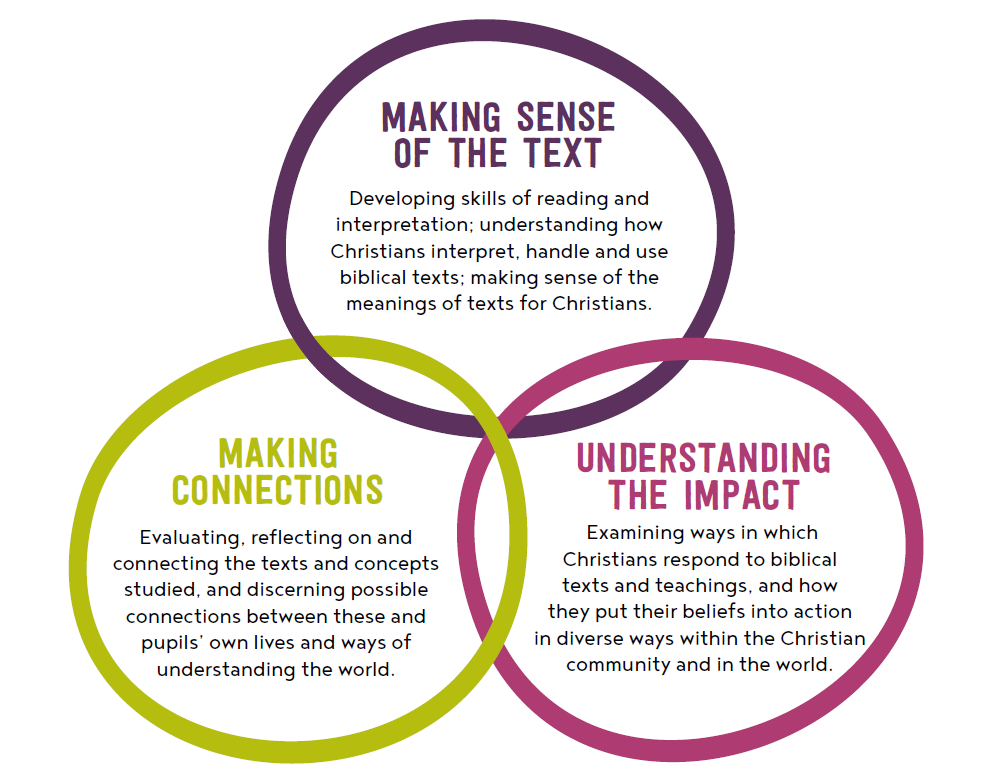
Our vision is to ensure that children leave our school with the ability to think for themselves. We believe it is paramount to explore other world faiths in order to celebrate and foster an awareness of the differences that exist within our school, community and the wider world. It is essential that our RE curriculum ensures that we enable the children to show respect for diversity and differences, whilst simultaneously encouraging them to identify the similarities. We cover a breadth of Faiths to best reflect our community.
We will cover in by the end of Key Stage 1: Christianity, Judaism, Islam, and Hinduism
We will cover in by the end of Key Stage 2: Christianity, Hinduism, Islam, Judaism, Buddhism, Sikhism and Humanism.
Our school values and ethos underpin and drive everything we do here at John Fletcher of Madeley Primary.
Hope and Aspiration: “We believe we can”
We want to inspire our learners and the community to see learning as a joy: a gateway to a successful future.
Resilience and Perseverance: “We know we can”
Our School was named after John William Fletcher, the Vicar of Madeley, who was one of the founders of the Methodist Societies which later became known as the Methodist Church. John Fletcher was a humble man of great faith. He chose to fulfil his mission within Madeley, knowing he would have a difficult challenge. Everything he did, he worked with his whole heart. And so, we want all our learners and school community to have a positive mindset: to be able to have the self-belief to work through something when it is difficult.
Compassion and Forgiveness: “Together we can”
Recognising that everyone is different and everyone is precious, we want to foster a safe learning environment by supporting our school community to love each other unconditionally, taking care of each other and our environment. This means to treat each other and our environment with love, kindness, respect and to show forgiveness for one another.
Religious education has a unique place as a central subject in the curriculum of John Fletcher of Madeley. It is neither a core nor a foundation subject; the 1988 Education Act states that ‘Religious Education has equal standing in relation to core subjects of the National Curriculum in that it is compulsory for all registered pupils’.
John Fletcher of Madeley RE Currciulum
Below is our full rationale:
RE Curriculum Rationale
Collective Worship
Collective Worship is given special status in our school. We begin our school day with a dedicated time for Collective Worship, either as a Key Stage, whole school or through child-led planning and delivery within class.
Collective Worship Policy
We have developed a Collective worship programme that follows the Liturgical Year, as well as celebrates our own school values in turn.
On a Friday, we celebrate children’s achievements academically as well as how they have lived our school values personally and towards one another. If nominated, the children’s achievements are logged in our Purple Book and they have a certificate. We always focus our reflection on the theme for the week.