English is a core subject of the curriculum and is central to the wider curriculum and fundamental to every child’s learning both at school and in the world beyond. Children need to develop their use of language in order to learn and to play a full and active role as individuals in society. It is central as a medium of thought, learning and expression across the curriculum and also as a subject in its own right.
English across the curriculum
As a school we recognise that English knowledge should be regularly applied in every subject area and that, where appropriate, English teaching should be linked to work in other areas of the curriculum. The teaching of English, through access to quality texts is an important part of SMSC development, as well as developing Cultural Capital. This is taken into account through medium and short term planning where links with other subjects are made evident.
National Curriculum
The overarching aim for English in the national curriculum is to promote high standards of language and literacy by equipping pupils with a strong command of the spoken and written word, and to develop their love of literature through widespread reading for enjoyment. The national curriculum for English aims to ensure that all pupils:
- read easily, fluently and with good understanding
- develop the habit of reading widely and often, for both pleasure and information
- acquire a wide vocabulary, an understanding of grammar and knowledge of linguistic conventions for reading, writing and spoken language
- appreciate our rich and varied literary heritage
- write clearly, accurately and coherently, adapting their language and style in and for a range of contexts, purposes and audiences
- use discussion in order to learn; they should be able to elaborate and explain clearly their understanding and ideas
- are competent in the arts of speaking and listening, making formal presentations, demonstrating to others and participating in debate.
The programmes of study for reading at key stages 1 and 2 consist of two dimensions:
- word reading
- comprehension (both listening and reading).
It is essential that teaching develops pupils’ competence in these two dimensions. In addition, pupils should be taught how to plan, revise and evaluate their writing. These aspects of writing have been incorporated into the programmes of study for composition. Writing down ideas fluently depends on effective transcription: that is, on spelling quickly and accurately through knowing the relationship between sounds and letters (phonics) and understanding the morphology (word structure) and orthography (spelling structure) of words. Effective composition involves forming, articulating and communicating ideas, and then organising them coherently for a reader. This requires clarity, awareness of the audience, purpose and context, and an increasingly wide knowledge of vocabulary and grammar. Writing also depends on fluent, legible and, eventually, speedy handwriting. Writing and reading complement each other and feeds pupils’ imagination, opening up a treasure-house of wonder and joy for curious young minds.
Writing and Communication Intent
We believe that a quality English curriculum should develop children’s love of reading, writing and discussion and that all pupils should be able to confidently communicate their knowledge, ideas and emotions through their writing and speaking. We want pupils to acquire a wide vocabulary, a solid understanding of grammar and be able to spell new words by effectively applying the spelling patterns and rules they learn throughout their time in primary school. We want them to write clearly, accurately and coherently, adapting their language and style in and for a range of contexts, purposes and audiences. We believe that all pupils should be encouraged to take pride in the presentation of their writing, in part by developing a good, joined, handwriting style by the time they reach upper Key Stage 2.
Pupils should read a wide range of texts for pleasure in order to develop culturally, emotionally, intellectually, socially and spiritually. This will then allow them to become curious and competent writers that can communicate confidently and effectively. Thus allowing them to become successful global citizens.
Characteristics of a Writer
- The ability to write fluently and with interesting detail on a number of topics throughout the curriculum.
- A vivid imagination which makes readers engage with and enjoy their writing.
- A highly developed vocabulary and an excellent knowledge of writing techniques to extend details or description.
- Well-organised and structured writing, which includes a variety of sentence structures.
- A curiosity of language and word origins
- Excellent transcription skills that ensure their writing is well presented and punctuated, spelled correctly and neat.
- A love of writing and an appreciation of its educational, cultural and entertainment values.
Progression in Writing
Writing Progression Grid
In EYFS and Key Stage 1, children will begin their early literacy learning with Read Write Inc. The writing and speaking will be incorporated into these lessons. They develop story retelling orally at first, using our Talk 4 Writing approach, which is our main approach for writing across the school.
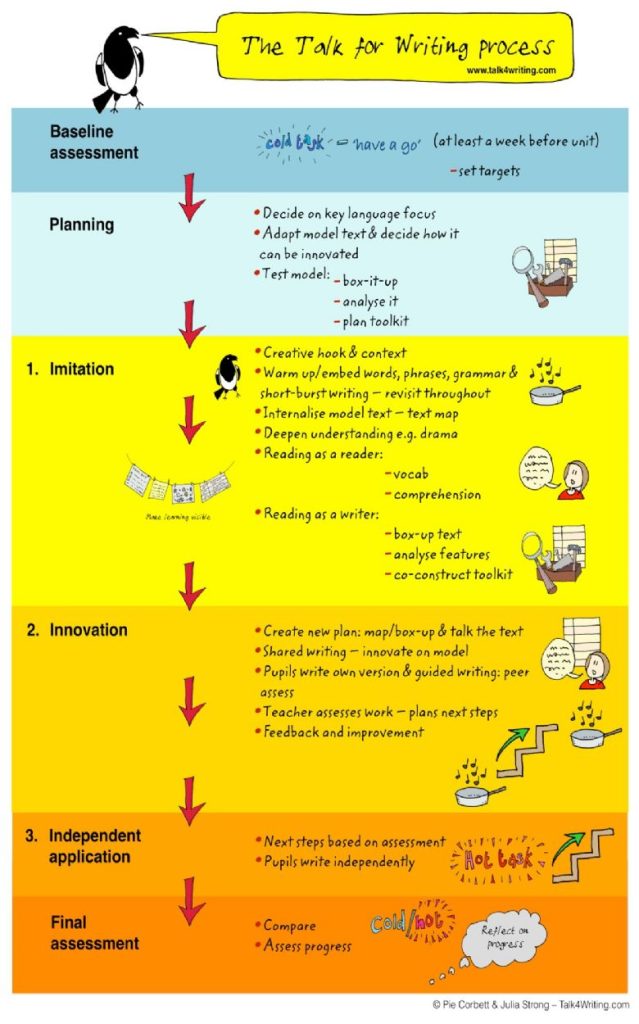
What is Talk 4 Writing?
Talk for Writing is a way of teaching writing that helps children become confident, imaginative and accurate writers. It is based on the idea that children learn to write best when they can first talk about and fully understand the type of writing they are going to create.
How Talk for Writing Works
1. Imitation – Learning the Model Text
Children begin by exploring a high-quality example of the type of writing they will produce (a story, letter, instructions, etc.).
They:
- Hear it read aloud
- Discuss the meaning
- Learn it using actions and story maps
- Explore new vocabulary and key language patterns
This builds confidence and a strong “story in the head”.
- Innovation – Adapting the Text
Next, children use what they have learned to change the model text.
They might:
- Change characters or settings
- Add new ideas
- Improve parts of the original
Teachers model writing step-by-step so children can see how to plan, compose and edit with support.
- Invention – Writing Independently
Finally, children write their own completely new piece of work.
They plan, draft and revise independently, using the structures and techniques they’ve practised.
Why We Use Talk for Writing
- Builds speaking, listening and thinking skills
- Increases confidence and creativity
- Gives clear structures for successful writing
- Helps all learners, including those needing extra support
- Improves vocabulary, grammar and understanding of text features
How Parents Can Help at Home
- Encourage children to retell stories or explain their class text
- Read and talk about books together
- Play with new vocabulary
- Praise effort and ideas in your child’s writing
- Ask them to teach you the actions or story map they are learning
Reading
See following page